Showing posts with label video. Show all posts

Wednesday, March 9, 2011

Kanda Myojin Shrine Misogi - Japanese Shinto Purification Ritual with Freezing Cold Water

Kanda Myojin Shrine Misogi (Cold Water) Purification Ritual
No Blues From This Wintry Dip in 2007
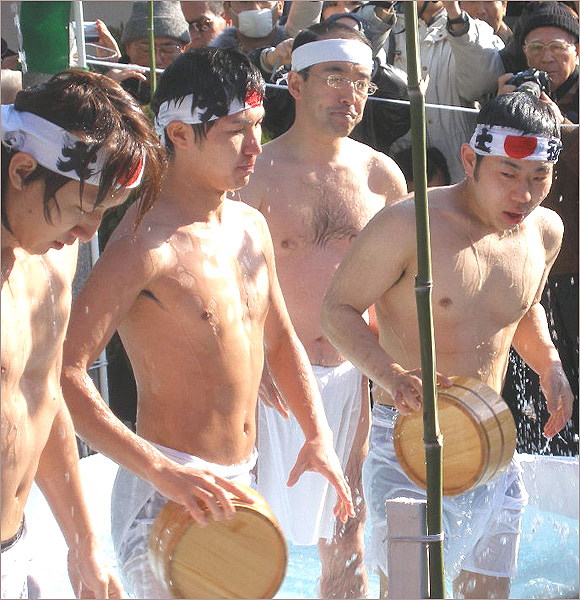

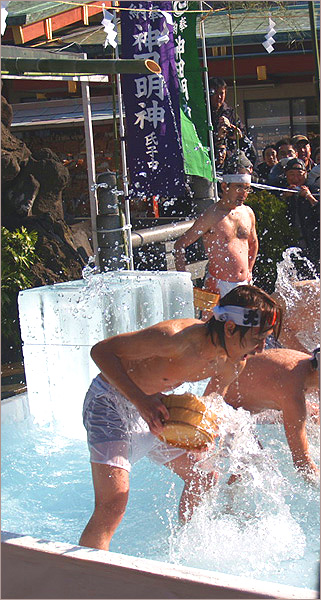
Misogi Participants purify themselves with freezing cold water


"From the earliest period Shinto exacted scrupulous cleanliness... It is not uncommon for the very fervent worshipper to invoke the gods as he stands naked under the ice-cold rush of a [waterfall] in midwinter." - Lafcadio Hearn, Japan: an Attempt at Interpretation, 1904.

TIME: 2nd Saturday of January around 11
PLACE: Kanda Myojin Shrine, Tokyo
GETTING THERE: Ochanomizu Stn from JR Line and Maranouchi Subway


Misogi is an ascetic practice of ritual purification in which the participants immerse themselves in freezing cold water. This activity takes place in Winter typically close to New Years at many temples and shrines throughout Japan and special places along rivers and at waterfalls especially in the mountains. Misogi participants will wear white which represents purity. The men wear only a loincloth known as a fundoshi and a headband. Women will wear a kimono and headband.


At Kanda Myojin Shrine the participants do a "warm-up" both mentally and physically before stepping into a pool of water with chunks of ice floating in it. They take wooden buckets and splash themselves vigorously with them. After everyone in the group has done their cold water purification, they do more stretching and chanting.


This is from an article I wrote for OhMyNews several years ago when Tokyo had a very mild January

Recently an annual purification ritual at Tokyo's Kanda Myojin Shrine was held. The ritual involved men and women jumping into a shallow pool of freezing cold natural water and showering themselves vigorously with bucketfuls of icy water. These purification-through-freezing-water rituals known as Misogi are often held in winter to display the fierce dedication of the participants.
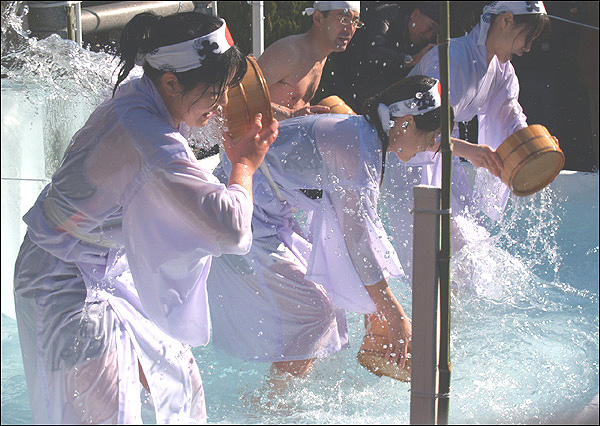


Young girls brave the cold water and the warm winter


Most winters, particularly the record cold one last year, this ritual would be viewed as brave, strong, and more than a little insane. However, this winter, given the abnormally warm temperatures, it actually looked rather refreshing.
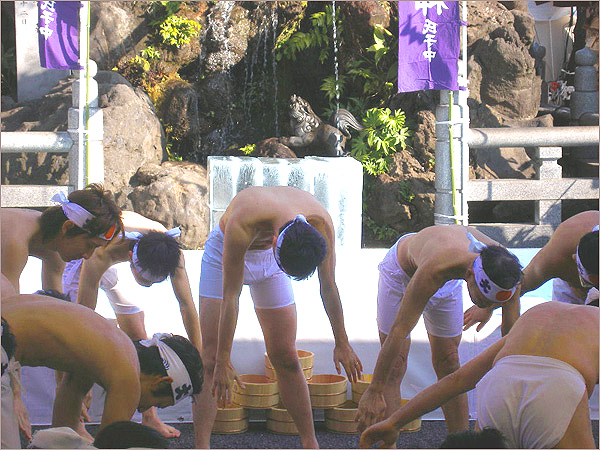
Preparing For Their Refreshing Wintry Dip


With the exception of a few storms here and there, Japan's winter has been exceptionally warm this year. This is in sharp contrast to last year when record snowfalls blanketed the northwestern coast and over a hundred people died in snow-related injuries. 
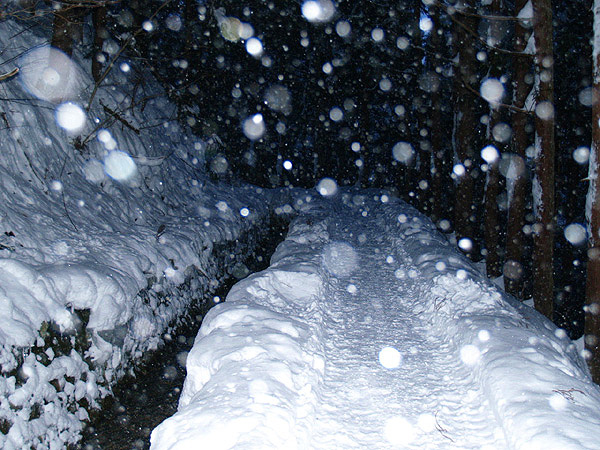
Heavy snowfall last winter In Nagano


Even Tokyo was hit with a significant amount of snow.
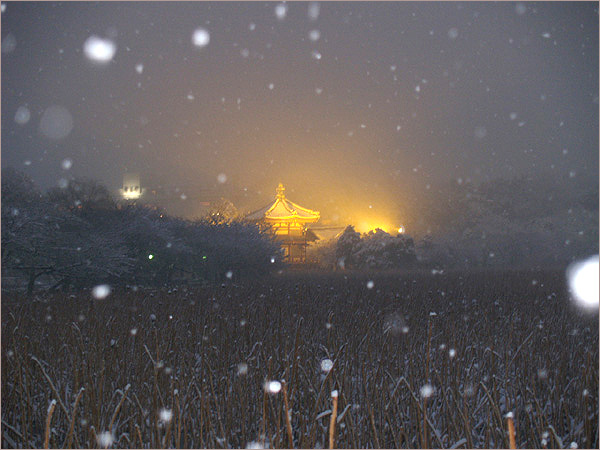
Last winter's snow in Ueno Park in Tokyo


The winter has also been conspicuously late in coming. Autumn leaf viewing has long been a popular tradition in Japan, but usually in autumn! Autumn and winter seemed to have set their seasonal alarm clocks rather late. People were viewing autumn leaves in Kyoto as late as New Year's Eve!
A number of Japanese ski slopes only received their first heavy snow within the last few weeks. Several skiing events had to be canceled or relocated to better slopes.


The warm weather is not only in Japan. Prior to the ice storms now sweeping across much of the US, the weather in many places felt like a fine day in April rather than January. The ice storms themselves are byproduct of the unnaturally warm weather.
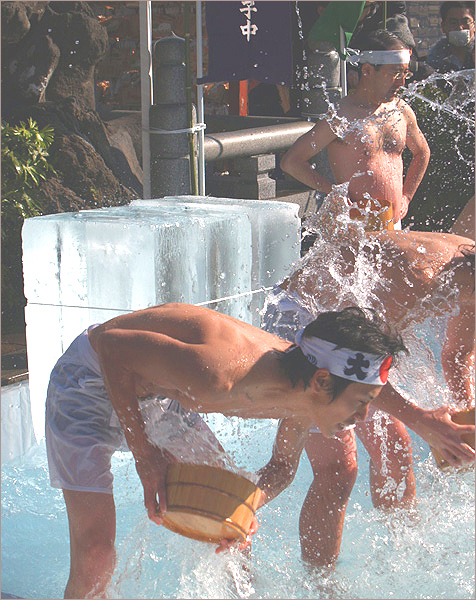


Perhaps former U.S. Vice President Al Gore saw the Kanda Myojin Shrine event and took note of the lack of blue skin of the participants, because he was in Japan recently urging Japanese business leaders to set the example for the world to follow on environmental policies.


Gore mentioned Japan's unusually warm winter, and the early blooming cherry blossoms in Washington D.C. were also ominous signs that not all was well.
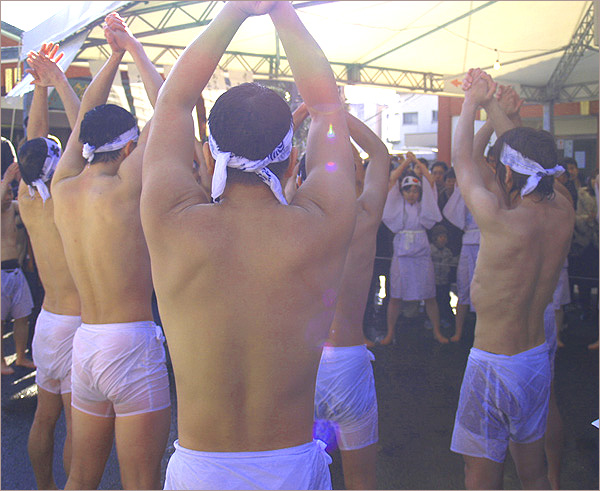
Stretching out their cold limbs after their dip


"Our planet now has a fever. And it's not going away," Gore said. "We have a moral obligation to those coming after us."


Gore was also promoting his documentary on global warming, An Inconvenient Truth

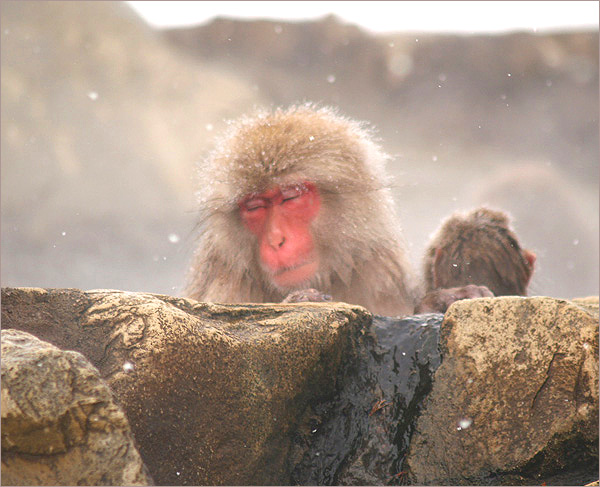
Obvilously smarter than us, the Japanese snow monkey prefers a hot bath to a cold one in winter


The Golden Dragon Dance of Tokyo

The Golden Dragon Dance of Tokyo
Golden Dragon Dance Celebrates Asakusa's Beginning


The Golden Dragon of Asakusa


TIME: March 18&Nov 18 11:00, 1:30, & 3:30
PLACE: Asakusa, Tokyo
GETTING THERE: GINZA or TOEI ASAKUSA Subway


Once a year in Asakusa, located in the northeast edge of Tokyo, a special kind of early spring ritual dance is held. The dance -- called "Kinryu-no-Mai" in Japanese -- is conducted not by people but by a golden dragon.

Naturally, it's not a real dragon but the dance commemorates the visitation of a "real" dragon of golden hue that appeared over 1,300 years ago.


The golden dragon entertains the crowd.

The golden dragon of today is merely a diminutive representation of the mighty majestic beast that dropped from the heavens one day long ago. The copy is a mere 15 meters long and weighs in at 75 kilos, while the real one was reportedly 30 meters long and weighed who knows what.


The golden dragon at rest

What brought about this unexpected celestial visitation was the discovery of a small golden statuette of a Buddhist deity by two fishermen in the Sumida River on March 18, 628. The statue depicted Kannon, a popular deity known for her compassion in the face of human suffering.


Touching the dragon's head is thought to bring good fortune.

This small statue was enshrined and the area later became a popular spot for pilgrims. Over time, the village of Asakusa expanded and its temple, Sensoji, where the statue was kept, grew in importance.

Had the visiting dragon been of Western extraction, it no doubt would have devoured the two fishermen on the spot and made off with the golden statue and taken it to its private hoard.


The golden dragon about to devour a photographer

Oriental dragons, however, are generally more benevolent. They're known for dispensing wisdom and happiness rather than fire and poisonous fumes.

Golden dragons are rarely seen because they are often invisible. They only appear at certain moments to mark auspicious events, as one dragon did when the Kannon statue was found.


Ladies in Geisha costume provide the Golden Dragon with Traditional music to dance to

The golden dragon dance is held in honor of both the dragon's visit and the statue's discovery which basically help to create Asakusa. Eight men hold the dragon aloft on poles and twist it about while ladies made up like geishas play music on traditional instruments. The dragon dances three times before it disappears for another year. (though it makes a reappearance in November)


A mural of the dragon dance on the wall of Asakusa Station


Uchiwa Matsuri - Japanese Fan Festival of Kumagaya

UCHIWA MATSURI OF KUMAGAYA
JAPANESE FAN FESTIVAL


TIME: July 20-22 - The evening of the 22nd is the main event
PLACE: Kumagaya, Saitama Prefecture (north of Tokyo)
GETTING THERE: Takasaki Line


Summer time is the time for matsuri -- or festivals -- in Japan. It seems like just about every city, town and village has some form of matsuri going on throughout the summer. Somematsuri are famous and pull in people from all over the world. Others are more local events. But big or small, matsuri can be a lot of fun.


Kumagaya's Uchiwa Matsuri


Just north of Tokyo, the small city of Kumagaya hosts severalmatsuri throughout the year. The Uchiwa Matsuri held at the end of July seems to be held just for the sake of having a good time. The origin of this festival is rather mundane. In the late 19th century, shops would hand out free fans -- Uchiwa -- to all passerbys and customers around the third weekend of July. Perhaps the sudden generosity of the shop owners so surprised the citizens of Kumagaya that they felt like putting together a festival just to celebrate it.


Uchiwa - Flat Fans
Fans that cool and advertise

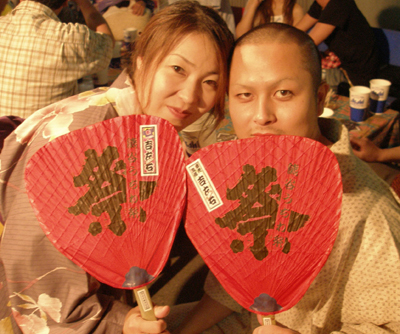
A couple holding traditional Uchiwa - flat fans


Uchiwa are flat fans originally constructed of paper and bamboo. Nowadays, plastic and wood is more often used. They are often carried at festivals. Stores of today and yesteryear pass out free Uchiwa as advertisements with the practical (not too mention thoughtful) purpose of fanning oneself off during the hot, humid Japanese summer. Uchiwaare thought to have come from Korea.


As it is, Kumagaya, generally has the highest temperatures in the Tokyo region during the summer. Free fans would have been a blessing before the advent of electric fans and air conditioning.


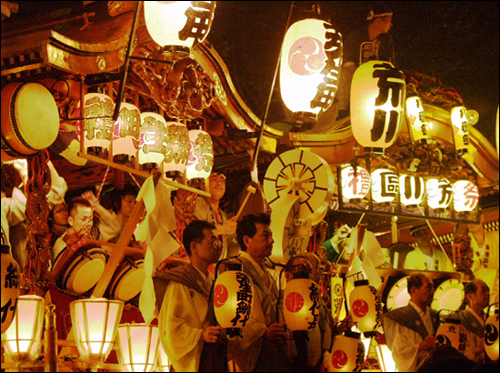
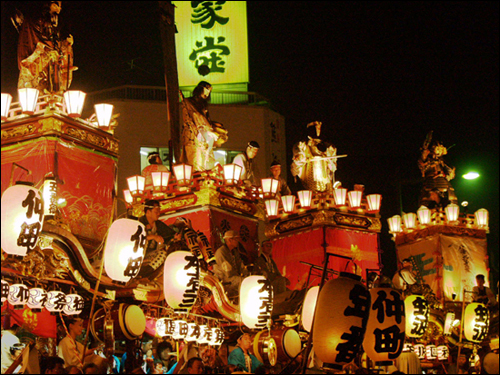
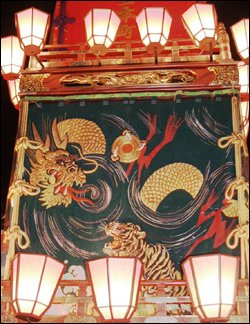
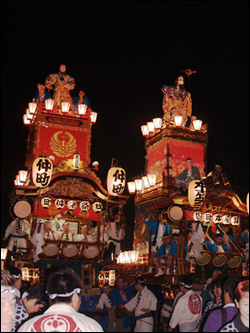
Floats at Kumagaya's Uchiwa Matsuri


Summer matsuri serve as a traditional means of escape from the oppressing humidity that is the Japanese summer. These events allow the Japanese to forget their weather-induced misery for a while as they kick up their geta (wooden clogs) and dance. The citizens of Kumagaya no doubt felt they needed a matsuri to save them from the high temperatures they repeatedly suffer from and thus (perhaps) the Uchiwa Matsuri was born.


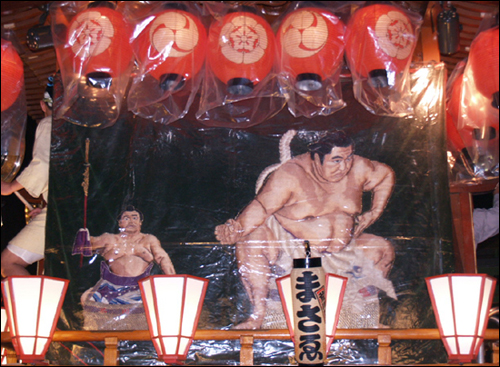
Images of sumo wrestlers decorate a float.

As matsuri go, the Uchiwa Matsuri is not very famous. I had never heard of it even though I had a book on Japanese Festivals. Many of my students who lived in the Saitama region north of Tokyo where Kumagaya lies had never heard of it either.

I stumbled across a reference to the festival in a newspaper just by chance only a few hours before going to it. Doing a little research on the net only netted me a blurry cell phone picture of one of the festival's floats. Armed with such little information, I decided to chance it anyway and give the unknown Uchiwa Matsuri a try. I was pleasantly surprised by what I found.


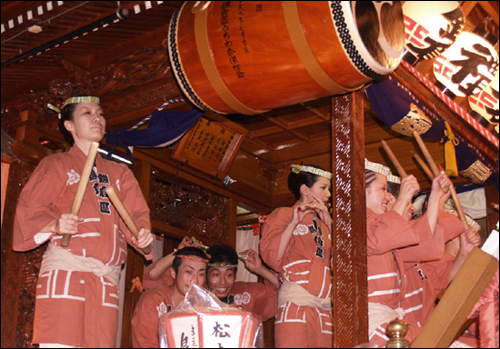
Kumagaya was packed with people to see what I thought would be a minor event. Following the crowds and the noise, I found a large half-circle of a dozen rather sizable decorative floats filled with drummers and flute players. They were making a cacophony of noise by beating drums, blowing on shrill flutes, and banging platters of metal. It was like a medieval-version of heavy metal garage band.


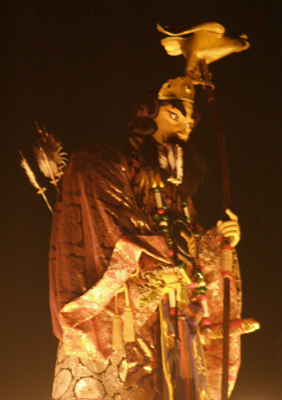
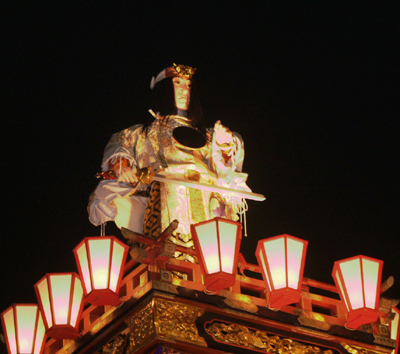
Five of the floats were quite tall and were topped with a mannequin figure representing legendary persons from the past. One figure was Jimmu, the legendary first emperor of Japan who supposedly ruled Japan in the 5th century B.C. -- there is no evidence to support this, however.


Legendary Emperor Jimmu
Mythical founder of the Japanese Imperial Line

Emperor Jimmu and his divine crow companion


Jimmu according to ancient tradition was the first human emperor of Japan. He supposedly reigned in the 5th Century B.C. He is often depicted carrying a bow accompanied by a crow. The crow was Yatagarasu - a three legged crow that came from heaven to aid Jimmu in conquering the land. Jimmu extended his kingdom from the southern island of Kyushu into the mainland area that is today Kansai. There is no evidence that Jimmu ever really existed but his story is believed to be an echo of the migrations of the Yamato people from Kyushu to Kansai. The head of the Yamato would eventually become the Emperor of Japan.


Another was an early hero -- Prince Yamatotakeru. The only true historical character was Kumagai Naozane, a warrior of the late 12th century. Kumagaya is named after this warrior who was born in the area. He was famous for fighting and reluctantly killing a young samurai in the Gempei War.


Yamatotakeru
Ancient cross-dressing hero

Yamatotakeru - early folk hero


Yamatotakeru was the crown prince during the reign on Emperor Keiko in the 2nd Century AD. He is one of the first folk heroes of Japan and served as a proto-type for the samurai of later ages. One of his most famous exploits involved a bit of crossdressing. A powerful local enemy was causing problems in the realm. To defeat him, Yamatotakeru disquised himself as a maiden and entered his enemy's camp successfully. So convincing was his disguise that the leader was smitten by the prince in drag. He drank long into the night with his newfound love until he fell into a stupor whereupon Yamatotakeru stabbed him to death. His sneaky tactics seem to have inspired the later-day devious Ninja more so than the straightforward samurai.


After a time the floats were pulled away down the streets to regroup in the town center where even more people gathered. It was so crowded that a person could hardly even wave a fan to cool themselves.


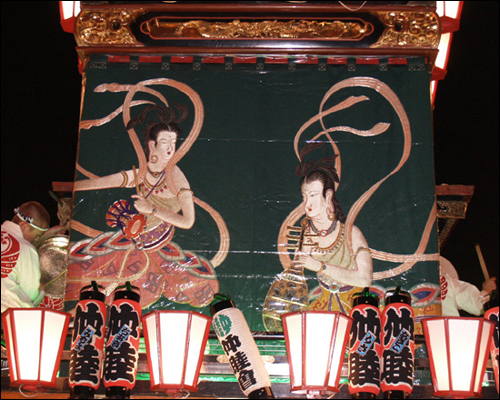
A pair of Japanese angels grace this Uchiwa Matsuri float.

Noise, noise, noise seemed to be the order of the day at the Uchiwa Matsuri. But one thing I noticed conspicuously absent on all those decorative floats was any mention or depiction of the festival's namesake -- fans. Sure, there were fans a-plenty in the crowd both folding and flat but this was to be expected considering the heat. I was expecting floats that were either in the shape of fans or floats covered with fans. Perhaps given the heat, fans on floats would have been seen as a dreadful misuse.

However, despite the fanlessness of the festival, I thoroughly enjoyed the Uchiwa Matsuri. It was a wonderful, unexpected surprise.