Showing posts with label Japanese culture. Show all posts

Wednesday, March 9, 2011

Sakura - Japanese Cherry Blossoms

The Short, Happy Life of the Cherry Blossom


Shikishima no
Yamato-gokoro wo
Hito-towaba,
Asahi ni niou
Yamazakura bana.


(If one should ask you concerning the heart of a true Japanese, point to the wild cherry flower glowing in the sun.)


-- Norinaga Motoori (1730-1801)

Cherry blossoms, called sakura in Japanese, are taken very seriously in Japan. Any tourist or long-term visitor can easily notice this whatever time of the year they arrive. Sakura can be seen everywhere -- art, tea cups, TV commercials, wrapping paper, and so on.


The Great Buddha of Kamakura with cherry blossoms

The official flower of the Japanese imperial family is the stately (and hard-to-pronounce) chrysanthemum. The unofficial national flower is the cherry blossom. Of all the flowers and blossoms in Japan only the cherry blossom can bring the country to a halt: Japanese drop whatever they are doing to rush and grab a blue tarp mat so they can sit under the blossoms.


Every spring, the Japanese wait eagerly with an anticipation that borders on mania for the first blooming of the cherry blossoms. They have been doing this for well over a thousand years.


Enjoying a cherry blossom "snowfall"

Flowers and blossoms are revered to such a degree in Japan that blooming times are duly noted on calendars and Japanese often plan their vacations around them.


The blooming of the cherry blossom is the most important and the most widely celebrated. In spring, cherry trees barren from winter's cold grip suddenly burst forth into color and transform the landscape into a fairy tale-like wonder world.


Ogaki Castle defended by a row of cherry trees.

Even bleak urban centers become almost welcoming under a canopy of pink and white and sometimes yellow blossoms. Cherry blossoms accentuate traditional places such as shrines, temples and castles to their fullest glory. Samurai warlords often went to great lengths to beautify their castles, built for defense, with gardens, fish ponds, and cherry trees.


A lone blossom petal floats upon the water of a shrine's purification basin.

The samurai warriors of Old Japan came to take the cherry blossom as their spiritual motif. They saw in the beautiful but brief life of the sakura their own fate. The sakura falls at the height of its beauty rather than withering away. This "death" is much in the same way the samurai wished to die: In the war-torn period of Japan many samurai, like the blossoms, fell at the height of their youth and glory long before reaching old age.


Enjoying the blossoms with just a few thousand others.

Nighttime finds the Japanese gathered under the blossoms to drink, eat, and be merry as they have done for generations. Hanami (cherry blossom viewing parties) is a tradition that goes back to at least the Nara Period (710-784). Hanami was originally an aspect of Chinese influence, but it was the early-blooming plum blossoms that were honored. In the following period known as the Heien (794-1185), the cherry blossom won the attention of the Japanese and the word hanami came to be associated with cherry blossoms.


At first hanami was mainly the pastime of aristocrats but over time the practice spread to people of all walks of life. Hanami celebrants of the past enjoyed poetry games in which contestants tried to come up with new stanzas to continue a poem. Nowadays, for better or worse, portable karoake machines tend to take the place of poetry.


Food stalls selling all manner of Japanese cuisine are a common feature wherever the cherry blossoms are the thickest. Popular food items are okonomiyaki, a Japanese-type pancake of seafood and noodles, takoyaki, breaded balls containing octopus tentacle, yaki-tori, skewered chicken strips, and of course sushi.


An old cherry tree in Kyoto

The blooming season is brief -- too brief for the masses of overworked office workers. The peak period is a time for fleeing the shackles of the office.


Popular cherry blossom viewing spots are crammed with people, food vendors, and blue mats. Inebriated viewers often have a difficult time navigating themselves back to their party through a sea of hanami participants. Companies will book places in advance for their staff parties and send out rookie employees to guard the mats and alcohol during the day.


Clouds of cherry blossoms! / Is that temple bell in Ueno or Asakusa? -- Basho (17th Century)

With the arrival of Western visitors en masse to Japan in the late 19th century following the end of over two centuries of isolation, the Japanese mania for cherry blossoms every spring was viewed with some wry amusement. Certain visitors, who were more practical and with a mind for productivity, just could not see the attraction to trees that, while beautiful, did not bear fruit that could be eaten or sold. The cherry blossom was called by one such visitor as an aristocrat among flowers: not working but wanting to be admired for its beauty.


Boating under the cherry blossoms at Chidorigafuchi, Tokyo.

This view has changed and nowadays visitors together with the Japanese rush around to see the cherry blossom anywhere it blooms and admire its brief but beautiful life.

If there were no cherry blossoms in this world / How much more tranquil our hearts would be in spring. -- Ariwara no Narihira (10th Century)

TIME: Blooming varies but for much of Japan sakura blooms late March through early April. In Tohoku a popular spot is Hirosaki Castle which blooms in late April to early May
NOTE: There is no official "Cherry Blossom Festival" despite a number of people there is. Events (if any) vary from region to region. Most people just do hanami - sitting under the blossoms while eating and drinking.

Bunka no Hi: Japanese Culture Day

Bunka-no-Hi: Japanese Culture Day
Japan’s Culture Day Keeps Traditions Alive


Martial arts demonstrators sparring in sight of the Shinjuku Building on Culture Day.

In this fast-paced modern world of whizzing beeping flashing technology where people rush hurriedly about to keep up with these fast-changing times, it's all too easy to forget the traditions and customs of earlier slower times. Japan's efforts to keep a tenuous cultural link to its past is the national holiday known simply as Culture Day (Bunka-no-hi).


Culture Day (Nov. 3) was originally a holiday to celebrate the birth date of Emperor Meiji (1852-1912). After his death, his birthday was designated as Culture Day, a day in which cultural arts are honored.


A mother and 3-year old daughter dressed in Kimono visit Meiji Shrine

Honoring Imperial birthdays is a relatively new tradition. For long centuries, the Emperor was a shadowy figure controlled by the military dictators known as Shogun and before them the regents and ministers of the Imperial court.


Emperor Meiji was the first emperor in a long, long time to emerge from the shadows to reclaim the power and dignity of the Imperial family. The Shogun government was abolished in 1868, and Japan began its advancement into the modern world.


Yabusame archer prepares himself for the next target 

Culture Day also marks the day when the post-war constitution was officially announced -- Nov. 3, 1946.


Kendo competition at Budokan

Every year the Emperor awards individuals for their endeavors and accomplishments in the cultural arts or academic pursuits. The Order of Culture is one of the highest honors to be given from the Emperor. These awards are not limited to Japanese citizens, however. The American astronauts who first landed on the moon in 1969 received the Order of Culture.

Old and new come together

All over Japan many cities and villages put together various art and cultural presentations such as historical re-enactments, parades, festivals, martial arts demonstration, etc. Quite a number of adults and children will wear kimonos and visit shrines and temples. Traditional Japanese weddings are popularly held on this day too.


Yabusame archers of the Takeda School at Meiji shrine

Meiji Shrine which enshrines the spirit of Emperor Meiji, holds a number of events on Culture Day. Various martial arts are demonstrated using wooden and steel weapons. The mounted archery ritual known as Yabusame is performed as well. Yabusame involves an archer riding a fast horse along a narrow track while shooting arrows at two or three targets. In the past Yabusame was only performed by Samurai, but now women participate in the ritual as well. This shows that Culture Day is not some inflexible stuffy holiday designed to resist change but rather that it is adaptable to the changing times.


Youth practicing their skills and discipline at Budokan

On the grounds where the old Shogun Castle once stood, a kendo competition was held this Culture Day at the Budokan Hall. This is where the Beatles played when they toured Japan back in their heyday. Kendo is a traditional martial arts based on the samurai fencing schools of the past in which the participants garbed in armor from head to waist fight with swords of bamboo.


It's a nice day for a white wedding at Meiji Shrine. 

Whatever its origins, a Culture Day holiday is a wonderful idea. The modern world needs such days to reflect on the cultures of the past by both learning from the mistakes of the past so as not to repeat them and keeping traditional arts alive to be passed down to future generations.


Kendo
"The Way of the Sword"

Kendo is one of the oldest traditional martial arts still practiced by many in Japan. It derives from the old schools of sword fencing that samurai attended to improve themselves both physically, mentally, and spiritually.


Today many top Kendoka (practitioners of Kendo) are police officers. It's a rather expensive pastime to get into, as the equipment all told can run upwards in the thousands of dollars.


Kendoka use split bamboo swords and wear armor that covers most of their body. The most recognizable feature of their armor is the cage-like face mask. In competition earning points is quite difficult, as a Kendoka must demonstrate a perfect attack with sword, body, and spirit.


TIME: Nov 3rd
PLACE: All over Japan (check local listings) 
- The above article was mainly at Meiji Shrine and Budokan in Tokyo

Uchiwa Matsuri - Japanese Fan Festival of Kumagaya

UCHIWA MATSURI OF KUMAGAYA
JAPANESE FAN FESTIVAL


TIME: July 20-22 - The evening of the 22nd is the main event
PLACE: Kumagaya, Saitama Prefecture (north of Tokyo)
GETTING THERE: Takasaki Line


Summer time is the time for matsuri -- or festivals -- in Japan. It seems like just about every city, town and village has some form of matsuri going on throughout the summer. Somematsuri are famous and pull in people from all over the world. Others are more local events. But big or small, matsuri can be a lot of fun.


Kumagaya's Uchiwa Matsuri


Just north of Tokyo, the small city of Kumagaya hosts severalmatsuri throughout the year. The Uchiwa Matsuri held at the end of July seems to be held just for the sake of having a good time. The origin of this festival is rather mundane. In the late 19th century, shops would hand out free fans -- Uchiwa -- to all passerbys and customers around the third weekend of July. Perhaps the sudden generosity of the shop owners so surprised the citizens of Kumagaya that they felt like putting together a festival just to celebrate it.


Uchiwa - Flat Fans
Fans that cool and advertise

A couple holding traditional Uchiwa - flat fans


Uchiwa are flat fans originally constructed of paper and bamboo. Nowadays, plastic and wood is more often used. They are often carried at festivals. Stores of today and yesteryear pass out free Uchiwa as advertisements with the practical (not too mention thoughtful) purpose of fanning oneself off during the hot, humid Japanese summer. Uchiwaare thought to have come from Korea.


As it is, Kumagaya, generally has the highest temperatures in the Tokyo region during the summer. Free fans would have been a blessing before the advent of electric fans and air conditioning.


Floats at Kumagaya's Uchiwa Matsuri


Summer matsuri serve as a traditional means of escape from the oppressing humidity that is the Japanese summer. These events allow the Japanese to forget their weather-induced misery for a while as they kick up their geta (wooden clogs) and dance. The citizens of Kumagaya no doubt felt they needed a matsuri to save them from the high temperatures they repeatedly suffer from and thus (perhaps) the Uchiwa Matsuri was born.


Images of sumo wrestlers decorate a float.

As matsuri go, the Uchiwa Matsuri is not very famous. I had never heard of it even though I had a book on Japanese Festivals. Many of my students who lived in the Saitama region north of Tokyo where Kumagaya lies had never heard of it either.

I stumbled across a reference to the festival in a newspaper just by chance only a few hours before going to it. Doing a little research on the net only netted me a blurry cell phone picture of one of the festival's floats. Armed with such little information, I decided to chance it anyway and give the unknown Uchiwa Matsuri a try. I was pleasantly surprised by what I found.


Kumagaya was packed with people to see what I thought would be a minor event. Following the crowds and the noise, I found a large half-circle of a dozen rather sizable decorative floats filled with drummers and flute players. They were making a cacophony of noise by beating drums, blowing on shrill flutes, and banging platters of metal. It was like a medieval-version of heavy metal garage band.


Five of the floats were quite tall and were topped with a mannequin figure representing legendary persons from the past. One figure was Jimmu, the legendary first emperor of Japan who supposedly ruled Japan in the 5th century B.C. -- there is no evidence to support this, however.


Legendary Emperor Jimmu
Mythical founder of the Japanese Imperial Line

Emperor Jimmu and his divine crow companion


Jimmu according to ancient tradition was the first human emperor of Japan. He supposedly reigned in the 5th Century B.C. He is often depicted carrying a bow accompanied by a crow. The crow was Yatagarasu - a three legged crow that came from heaven to aid Jimmu in conquering the land. Jimmu extended his kingdom from the southern island of Kyushu into the mainland area that is today Kansai. There is no evidence that Jimmu ever really existed but his story is believed to be an echo of the migrations of the Yamato people from Kyushu to Kansai. The head of the Yamato would eventually become the Emperor of Japan.


Another was an early hero -- Prince Yamatotakeru. The only true historical character was Kumagai Naozane, a warrior of the late 12th century. Kumagaya is named after this warrior who was born in the area. He was famous for fighting and reluctantly killing a young samurai in the Gempei War.


Yamatotakeru
Ancient cross-dressing hero

Yamatotakeru - early folk hero


Yamatotakeru was the crown prince during the reign on Emperor Keiko in the 2nd Century AD. He is one of the first folk heroes of Japan and served as a proto-type for the samurai of later ages. One of his most famous exploits involved a bit of crossdressing. A powerful local enemy was causing problems in the realm. To defeat him, Yamatotakeru disquised himself as a maiden and entered his enemy's camp successfully. So convincing was his disguise that the leader was smitten by the prince in drag. He drank long into the night with his newfound love until he fell into a stupor whereupon Yamatotakeru stabbed him to death. His sneaky tactics seem to have inspired the later-day devious Ninja more so than the straightforward samurai.


After a time the floats were pulled away down the streets to regroup in the town center where even more people gathered. It was so crowded that a person could hardly even wave a fan to cool themselves.


A pair of Japanese angels grace this Uchiwa Matsuri float.

Noise, noise, noise seemed to be the order of the day at the Uchiwa Matsuri. But one thing I noticed conspicuously absent on all those decorative floats was any mention or depiction of the festival's namesake -- fans. Sure, there were fans a-plenty in the crowd both folding and flat but this was to be expected considering the heat. I was expecting floats that were either in the shape of fans or floats covered with fans. Perhaps given the heat, fans on floats would have been seen as a dreadful misuse.

However, despite the fanlessness of the festival, I thoroughly enjoyed the Uchiwa Matsuri. It was a wonderful, unexpected surprise.


Tuesday, March 8, 2011

Kuroishi Neputa Festival (2010)

Kuroishi Neputa Matsuri 2010


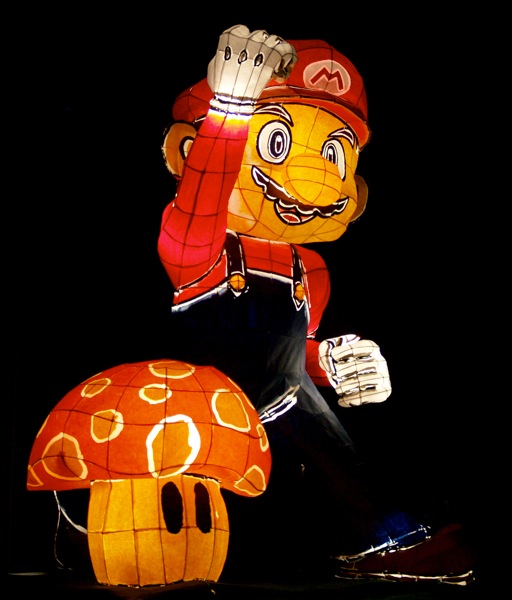
Kuroishi Neputa Matsuri is a Japanese festival in the small town of Kuroishi in the Aomori prefecture in the northern Japanese region called Tohoku. For the festival, the people of Kuroishi make floats of washi - japanese paper - and paint them with scenes from Japanese and Chinese history and legends. The floats are illuminated from within so it makes for some beautiful artwork.


The festival derives from the larger Neputa/Nebuta festivals of Aomori City and Hirosaki which goes back centuries. No one is quite sure of the origin of this festival. Some say it's a victory celebration of an old samurai general over the local inhabitants while others say it comes from farmers as a means of warding off the sleepiness that comes in summer.


TIME: First Week of August - evening time around 6-7
LOCATION: Kuroishi, Aomori Prefecture, Tohoku
GETTING THERE: Konan Train from Hirosaki (30 mins)


A scene from the Chinese tale "The Three Kingdoms"


The Hero Minamoto no Yoshitune with his mythical trainers 
the Tengu


Tengu are Japanese Goblins who help or trick humans


 Date Masamune - 16th Century warlord of the Tohoku Region